INSIGHTS
AI tools were built for laptops. 81% of Latin America only has a phone.
The “revolutionary” AI stack assumes high bandwidth, a desktop browser, and an afternoon to debug a failed upload. For 190 million mobile-only Latin Americans, that assumption is the product.
A design gap, not a connectivity gap.
In Brazil, Colombia, Mexico, and across all Latin America, 81% of people strictly own and operate on smartphones. Yet because most Artificial Intelligence tools are designed for laptop users, owning a smartphone becomes a tool of exclusion rather than one of empowerment.
AI has become a tool many of us rely on — for school, for work, for completing daily tasks. It has made us more efficient and unlocked new kinds of innovation. However, it has been designed for those who arguably need it the least. Regions such as Latin America cannot fully benefit from these powerful tools because they were not built with the region in mind. They were built in San Francisco and Mountain View, with assumptions about connectivity and device power that don’t match the reality of 190 million Latin Americans living in areas with coverage but no affordable access, or 80 percent of Peruvians experiencing quality-of-service issues that make real-time AI interaction nearly impossible.
We are building tools for laptops. 81% of the region doesn’t own one.
There is a clear design gap. We are building tools for laptops while the overwhelming majority of the Latin American population does not own one. According to Mexico Business News, most Latin American e-commerce platforms demonstrate critical deficiencies in technical performance and AI adoption. Eighty percent of platforms negatively impact users by blocking actions during content loading, and 21 of the 30 sites recorded unexpected layout shifts that cause disorientation. These aren’t global platforms — they’re local Latin American services failing to optimize for mobile.
I experienced this myself. When I started building for mobile-first contexts at Pillar, I realized the AI tools we wanted to integrate all assume high-bandwidth, desktop-first workflows. For a youth in — for example — rural Ecuador relying on a shared family smartphone with a weak 4G connection, many of these “revolutionary” tools are simply unusable.
Runway: a video tool you can’t actually edit video on.
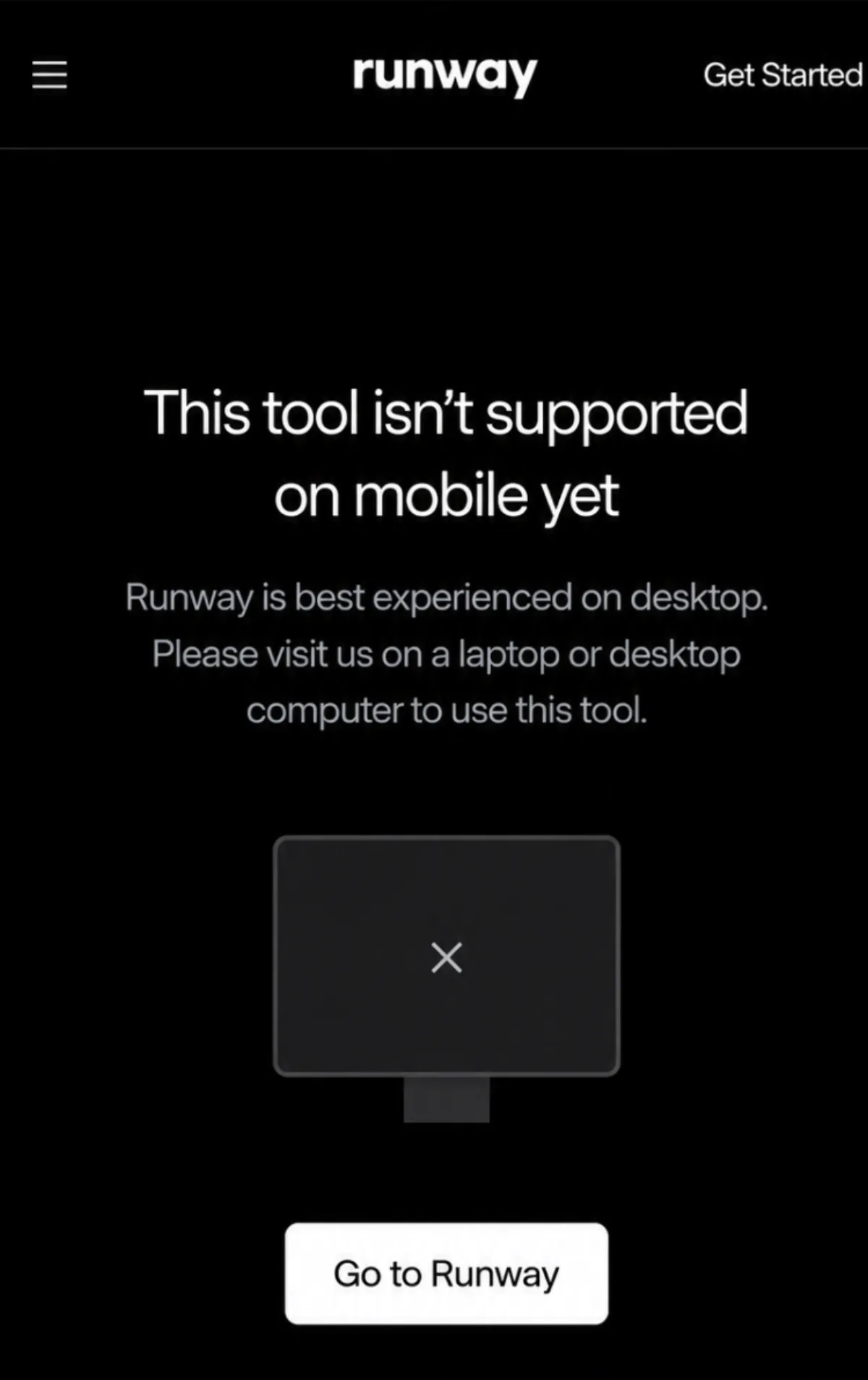
When we tried to use Runway from our mobile, we quickly hit a wall. The tool is browser-based. I had never considered this as a problem — until I could only use my phone. The interface wasn’t designed for a phone screen: buttons overlap, the video editor becomes a tiny, unusable space, and loading delays compound on weak connections.
What frustrated me most is that Runway’s mobile app does exist, but it’s explicitly a “companion” to the desktop experience. Therefore, this tool is a clear example of the design gap. If one strictly owns a mobile, they will not be able to create using Runway.
NotebookLM: research, unless you only have a phone.
As for NotebookLM, it is a tool I have used a lot for research and truly enjoy. The platform is marketed as a “research assistant,” but my mobile experience left me questioning this claim. The app documentation repeatedly flags features as “not available on mobile”. File uploads process slowly, and on a weak connection, they time out entirely.
When I tried uploading PDFs about historical figures from my phone, half of them failed with no clear error message. I decided to re-upload them later on the desktop and it did work. For a researcher in a rural area of Colombia who only has phone access, NotebookLM becomes a desktop-first tool that is pretending to be mobile-friendly. Why are all these powerful tools inaccessible from a mobile? Why has this not been targeted?
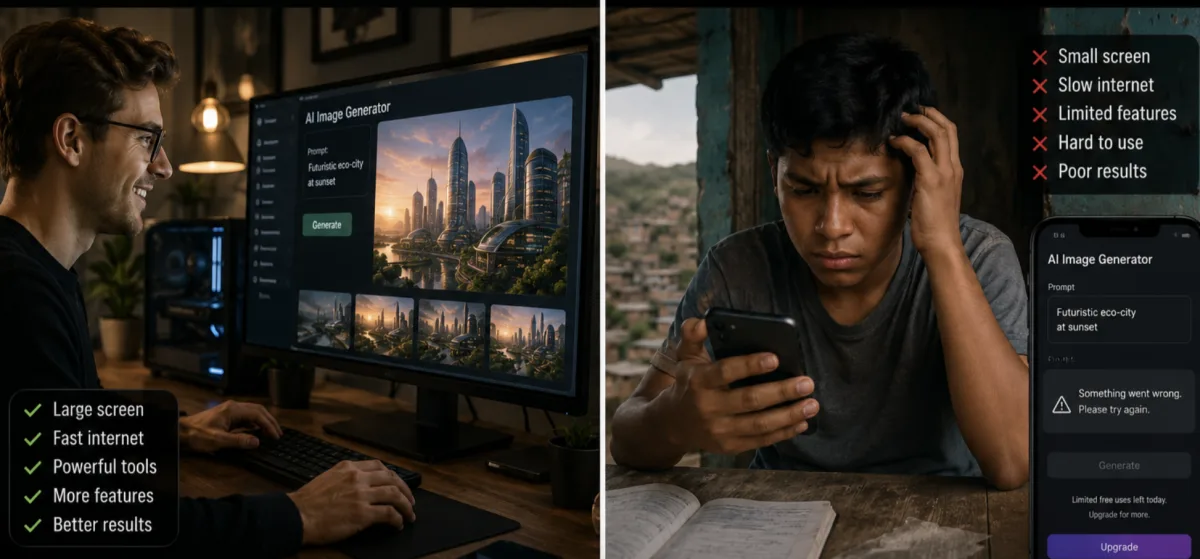
The pattern: desktop-first, mobile as afterthought.
There is a clear pattern. These tools which work beautifully on desktop become impossible to use once we move to mobile. They weren’t built mobile-first. They were built for desktops, then retrofitted for phones as an afterthought. And that afterthought becomes a complete blocker for anyone whose only option is a phone.
If we are serious about AI empowerment across Latin America, we must ask ourselves why these tools are not designed first for the 190 million mobile-only users and then optimized for desktops.
This leads me to question their design philosophy. Why is it that we always build innovative tools for those who need them less? Should we not be targeting the areas that would highly benefit from these tools? Why does Latin America’s adoption growth outpace its infrastructure readiness? And who is benefiting from this gap?
What “mobile-first AI” would actually require.
If a tool calls itself mobile-friendly, the test is simple: can a user with only a smartphone, on a weak 4G connection, do the entire job — not a watered-down version of the job? The current generation of AI tools fails that test by default. A more honest standard for the next generation would look like this:
- The primary surface is the phone. Not a responsive sidekick to the desktop product, but the canonical interface that all features ship on first.
- Upload pipelines tolerate weak networks. Resumable uploads, chunked transfers, visible progress, and clear error states — not silent timeouts on a 12MB PDF.
- Feature parity is the contract. If a feature ships on desktop, it ships on mobile. “Not available on mobile” is a product decision, not a constraint of the device.
- Tap targets and screen budget are designed for one hand. The default test device is a mid-range Android on a shared family plan, not the latest iPhone on office Wi-Fi.
None of these requirements are technically novel. They are simply not what the current crop of AI tools was built for. The teams that take them seriously will reach the 190 million mobile-only users the current cohort has effectively written off.
Sources & references
- Mexico Business News — reporting on technical performance and AI adoption across Latin American e-commerce platforms, including the 80% loading-block figure and the 21-of-30 layout-shift sample.
- GSMA Intelligence and regional digital-inclusion reports — underlying figures for the 81% mobile-only share and the 190 million coverage-but-no-affordable-access estimate.
- Runway — product positioning of the mobile app as a companion to the desktop experience.
- Google NotebookLM — product documentation flagging features as “not available on mobile.”
Frequently asked questions.
Why does mobile-first matter for AI tools in Latin America?
Mobile-first matters because 81% of people in Latin America strictly own and operate on smartphones. Approximately 190 million Latin Americans live in areas with mobile coverage but no affordable desktop access. When AI tools assume a laptop, that assumption excludes the overwhelming majority of users in the region. A tool that “has a mobile companion” is not the same as a tool that was built to work on a phone. For users whose only device is a smartphone, desktop-first AI is functionally unavailable, no matter how impressive its capabilities.
Why does Runway not work well on mobile?
Runway is browser-based, and its web interface was not designed for a phone screen. Buttons overlap, the video editor collapses into a tiny, unusable space, and loading delays compound on weak connections. Runway does offer a mobile app, but the company explicitly markets it as a companion to the desktop experience rather than a standalone creation environment. The implication is clear: if your only device is a smartphone, you cannot fully create with Runway. The design assumes a laptop sits next to the phone.
What is the problem with NotebookLM on mobile?
NotebookLM is marketed as a research assistant, but its mobile experience is degraded by design. The product documentation repeatedly flags features as not available on mobile. File uploads process slowly and, on weak connections, time out without a clear error message. PDFs that fail from a phone often succeed when re-uploaded from a desktop. For a researcher in rural Colombia whose only access is a smartphone, NotebookLM becomes a desktop-first tool pretending to be mobile-friendly. The capability gap between platforms is large enough to change what work is possible.
How many Latin Americans only have a smartphone?
Approximately 81% of people across Brazil, Colombia, Mexico, and the broader Latin America region rely strictly on smartphones for connectivity. An estimated 190 million Latin Americans live in areas with mobile coverage but no affordable desktop access. In Peru, around 80% of users experience quality-of-service issues that make real-time AI interaction unreliable. The scale of mobile-only users in the region is not a niche; it is the majority. Any product strategy that treats mobile as secondary is, by definition, treating the region as secondary.
What does the e-commerce data say about mobile performance in Latin America?
According to Mexico Business News, most Latin American e-commerce platforms show critical deficiencies in technical performance and AI adoption. Eighty percent of platforms negatively impact users by blocking actions during content loading, and 21 of 30 sites recorded unexpected layout shifts that cause disorientation. These are not global platforms being measured; they are local Latin American services failing to optimize for the very devices their users carry. The structural problem extends beyond AI tools and into the broader commerce surface of the region.
What should AI builders do differently for mobile-only users?
Builders should invert the design order. Instead of shipping a desktop product and bolting on a mobile companion, the primary experience should be designed for a single-handed smartphone on a weak 4G connection. That means tolerating low bandwidth in upload pipelines, providing clear error states when network conditions degrade, exposing full feature parity on small screens, and treating mobile-only as a first-class deployment target. The product question is no longer “can our desktop tool be opened on a phone” but “can a user with only a phone do the full job.”
Reach the 190 million on the right surface.
Pillar operates premium domain inventory and infrastructure across the Spanish, Portuguese, and French-speaking world — built for the mobile-first reality of Latin America, not retrofitted to it. Browse the inventory, or start a conversation about distribution.
Related learning
Go deeper on the frameworks behind this piece.
The Pillar Learning Library codifies the underlying frameworks for this analysis.